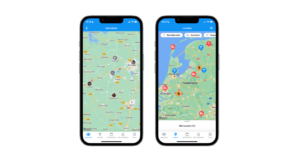


Everything you need to think about before, during and after the community launch
Starting a community often sounds simpler than it actually is. Many organizations immediately think of an app, platform or chat environment when they think of a community. But a successful community is ultimately not about technology. It’s about connection, engagement, clarity and behavior.
After all, why should people actively participate? How do you keep members coming back? What makes the community valuable? And how do you prevent a community from turning into a silent environment where nobody shares anything?
A strong community does not come about by itself. It requires a lot of preparation. In this blog, we take you through 12 steps on everything you need to think about before, during and after launching a community. From strategy and structure to activation, onboarding and long-term growth.
1. Start with the purpose of the community
A community without a clear purpose almost always runs aground. Before you think about modules, features or communications, you need to know why you want to start a community in the first place.
Therefore, ask yourself:
- What do we want to achieve?
- What problems do we solve?
- Why should people participate?
- What connection do we want to create?
- How should the community feel?
For example, a community can focus on:
- more connection between members
- knowledge sharing
- support
- collaboration
- centralize communication
- increase involvement
- online contact between physical moments
2. Think carefully about your target audience
Not every community works the same way.
An entrepreneurial network communicates differently than a sports club. And a resident community has different needs from a coworking space or volunteer organization.
Therefore, it is important to think about beforehand:
- who your target audience is
- how they communicate
- what they care about
- where their needs lie
- What barriers they experience
The better you understand your target audience, the easier it becomes to build a community that members enjoy using.
3. Take a critical look at how communication is happening now
Many communities arise because existing communications no longer work well. For example:
- Information gets lost in WhatsApp groups
- important updates disappear between calls
- communication is spread across multiple channels
- new members lack overview
Those very frustrations are often the basis for a stronger community. A community platform like Socie helps make communication more organized, centralized and clear.
4. Think about the culture of your community
A community is more than a collection of features. It is a place where people come together. That’s why the atmosphere within a community is incredibly important.
Determine in advance:
- how members interact with each other
- what you want to encourage
- what you would rather avoid
- How informal or professional the community is
- how much interaction you expect
A strong community feels safe, clear and accessible.
5. Make clear ground rules
To ensure that the community is used in the right way, it is useful to think about clear guidelines. This in turn also saves a lot of time in terms of content management. Guidelines can be turned into rules for members.
For example, think in advance about:
- what may be shared
- what would rather not
- promotions and commercial messages
- behavior and respect
- who has access to what
- who may respond within certain modules
A tip from Flip:
formulate rules positively.
Not:
“This is not allowed.”
But:
“This is how we keep the community valuable and manageable for everyone.”
Read more about community conduct rules in this blog.
6. Organize your community logically
A good community feels uncluttered. New members should understand immediately:
- where information is
- Where conversations take place
- where they can put something
- Where they can ask for help
Within Socie, you work with individual modules that you can customize to your community. Consider, for example:
Not every community needs everything. That’s precisely why it’s important to make conscious choices. Read more about 10 creative ways you can use the different modules here.
7. Think about activation in advance
A community does not live by itself. A common mistake: Launching the community and then waiting for members to become active on their own. That almost never happens.
You need to think about beforehand:
- how to get members excited
- how to lower thresholds
- what initial actions you ask for
- how to encourage activity
- what communications you use
Good activation starts before the launch.
Examples of activation:
- share announcements
- live commentary
- Using QR codes
- send reminders
- use ambassadors
- post examples
- getting members to do something directly
8. Make sure the community is pre-filled
An empty community does not feel welcome. In addition, it is not immediately clear what all is possible for members. That’s why you need to get content ready before launch.
Consider:
– welcome messages
– sample posts
– introductions
– events
– documents
– photos
– articles
– initial questions or polls
Thus, the community feels active and vibrant from day one.
9. Make onboarding as easy as possible
New members need to know exactly what to do. The smaller the first step,
the more likely people are to stay active. Therefore, don’t ask for too much right away.
For example:
- download the app
- join the community
- Via the qr code
- Or via the invitation link in the mail
- complete your profile
- introduce yourself
- respond to a message
That lowers the threshold tremendously.
10. Answers frequently asked questions
When you launch a new community, members will always have questions. Especially if they are switching from WhatsApp, for example, or haven’t worked with Socie before.
Therefore, think carefully in advance:
- what questions people may have
- Where doubt or resistance may arise
- Which information needs additional explanation
The better you answer these questions in advance, the smoother the transition will be.
A topic that comes up often is security and privacy.
For example, members want to know:
- Who can see their data
- where data is stored
- how notifications work
- Whether the community is AVG-proof
- Which privacy settings they can adjust themselves
By communicating this transparently from the beginning, you create trust and lower the threshold for active participation.
Other frequently asked questions may include:
- Why are we moving to a community platform?
- What is the advantage over WhatsApp?
- What is expected of me?
- What notifications will I receive?
- How active should I be?
- What can I share or not share?
- What happens if I don’t use the app?
- How do I set up my profile?
- Where can I get help with questions?
Tip
If necessary, create a separate FAQ or manual within the community so that members can always find answers easily.
11. Consider community management and ambassadors
A community does not manage itself. Especially in the early months, administrators play an important role.
She:
- stimulate conversations
- welcome new members
- place content
- guard the atmosphere
- help with questions
- provide activity
Therefore, a strong community always needs active community management.
Distribute management
Managing a community does not have to be done by one person. It is precisely when multiple people are involved in management that a community remains more active, personal and orderly.
Within the Socie app, you can use different administrator roles. This allows you to distribute management in a way that suits your community.
Community Administrators
Community administrators have access to all community settings. For example, they may:
- customize modules,
- manage settings,
- managing members,
- and determine the overall structure of the community.
Content managers
Content managers help manage specific sections within the community. Consider, for example:
- posting news items,
- managing activities,
- sharing updates,
- Or monitoring what is placed within a module.
Group Administrators
Group administrators manage a specific group within the community. For example:
- a working group,
- a team,
- a committee,
- an area group,
- or an interest group.
They can start conversations within their own group, help members and encourage activity.
Involve active members in management and make them ambassadors
Look within the community to see which members are actively involved. They feel like ambassadors of the community. Especially if they also become administrators. Perhaps someone responds a lot, actively helps other members or regularly shares valuable content. Those are often good people to give more responsibility within the community. For example:
- managing a group,
- mentoring new members,
- or placing content within a module.
This way you not only distribute management, but also increase engagement within the community.
A community often feels stronger when members contribute to the atmosphere, conversations and activity together.
12. Also think about the long term
You don’t build a successful community in one week. The strongest communities grow step by step.
Therefore, keep watching:
- involvement
- activity
- feedback
- new needs
- improvements
- recurrent interaction
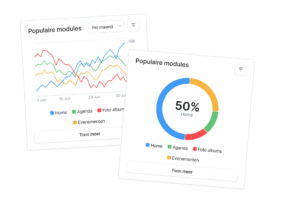
Much of this information can be found in the statistics within management and analysis.
Ask regularly:
- what are members missing?
- what parts work well?
- what could be better?
A community is never “finished.”
The most important lesson of all
In the end, a community is not about an app. It’s all about people. A platform is just the tool. The real value arises when members:
- get to know each other
- help each other
- start talks
- divide knowledge
- feeling part of something
Therefore, the strongest communities are not those with the most features,
but the communities in which people feel welcome, engaged and connected.
And exactly that is what a strong community is all about.